Learn about the history and current work of African American churches in Richmond from Benjamin Ross, church historian of Sixth Mount Zion Baptist Church and Dr. J. Elisha Burke, program director of SACRED SPACES.
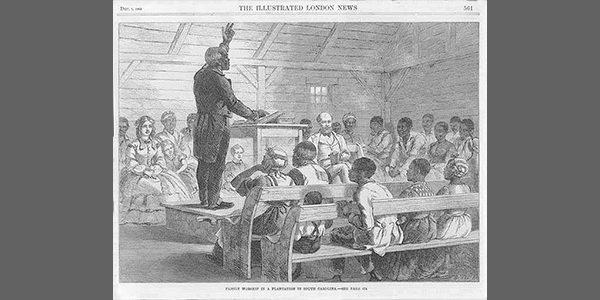
From the establishment of early pre-civil war African American churches through post-civil war and Reconstruction years, the African American church served as a hub of religious and social life. By the late 19th century and early 20th century, many churches provided assistance to aid formerly enslaved people and their families. During the civil rights movement, African American churches served as physical platforms for meetings and rallying services.
Today, African American churches continue their responsibility to care for the less fortunate and bring attention to the social injustices affecting the Black community. African American churches in Richmond remain active in social justice and civic engagement activities, specifically through the SACRED SPACES initiative which enables the Baptist General Convention of Virginia to provide training for new and current church historians.
These Community Zooms are at a new time of 12:30 p.m., so grab some lunch and join us online!
VCU’s Community Health Hub March 5, 2026 12:30 p.m.
The Junior League of Richmond April 9, 2026 12:30 p.m.
Guidelines
Prior to joining a session, attendees are encouraged to check that Zoom is working properly on their computers or devices by testing it at https://zoom.us/test.
At the start of every session, attendee’s microphones will be muted. This allows everyone to hear the organizers and presenters clearly. Attendees will be invited to unmute their microphones and speak at different times during the session.
If you have questions or comments while others are speaking, you can type them in the chat.
As at physical events, attendees are asked to help make sessions inclusive of all participants by using respectful language and allowing others to speak, even if they disagree with viewpoints being expressed.
VCU Libraries reserves the right to remove attendees from sessions for disruptive behavior.
For special accommodations, or to register offline, please contact Ryan Larson, event manager, rbpander@vcu.edu or 804-828-0593.
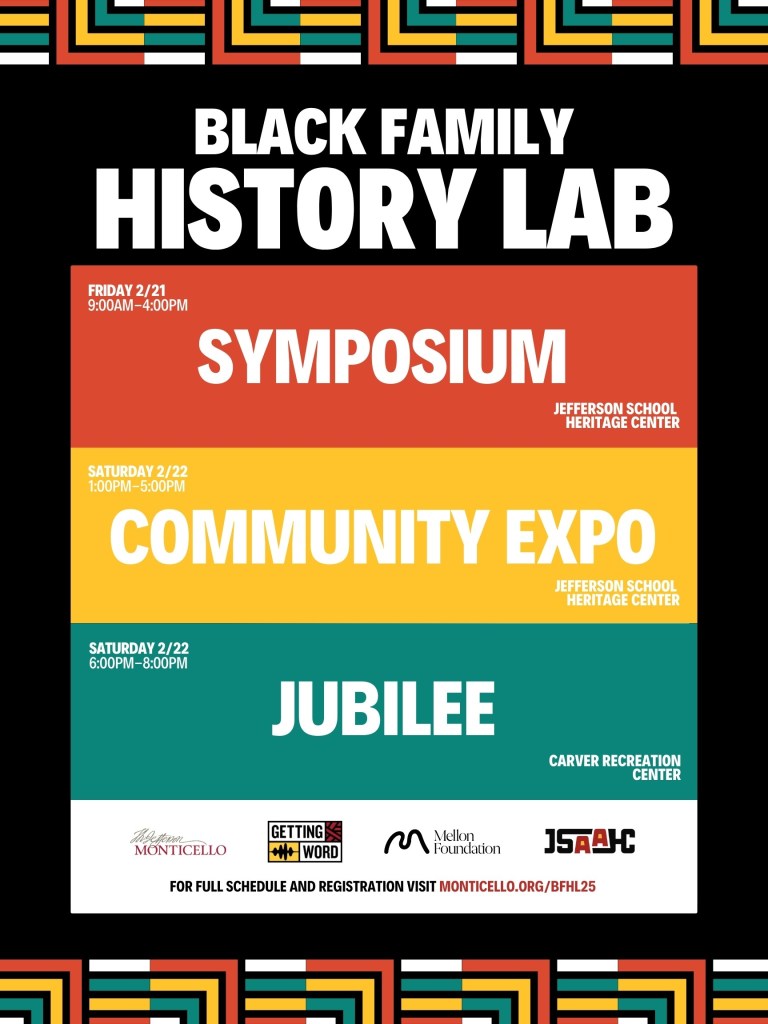
Back for 2025, Getting Word’s Black Family History Lab is a two-day program highlighting the interconnectedness of Black family legacies in the spirit of Ubuntu, an African philosophy meaning, “I am because we are.”
On Friday, February 21, join us for our Black Family History Lab Symposium at the Jefferson School African American Heritage Center. The symposium will explore the interwoven ties that bind together local and familial African American histories in Central Virginia and beyond. Engage in enriching panels, interactive workshops, and connect with others to foster a deeper sense of community, connection, and care.
For the full Symposium schedule and free registration, please visit this link.
On Saturday, February 22, come out for our Black Family History Lab Expo at the Jefferson School African American Heritage Center, where the richness of history meets the power of community! This event brings together a diverse mix of community-based organizations and local specialists to build a comprehensive network of support, inspiration, and resources tailored to help you safeguard your family’s legacy for the next generation.
Finally, the culminating event of the Black Family History Lab, the Jubilee Celebration, will take place at the Carver Recreation Center, featuring music, dance, and poetry performances by local organizations and artists that honor our heritage through their chosen medium.
Be sure to also check out our Facebook event page for other information and updates.
Recent history and future community-building will be the focus of VCU Libraries’ annual Black History Lecture Feb 4, 2025, “Building a Home for Change: The Obama Presidential Center.”
The Center’s Curator of Collections and Exhibitions, Dr. Crystal M. Moten, will provide an overview of the Obama Presidential Center focusing on the center’s museum exhibits. She will: explore the ways the exhibits are rooted in a larger, complex discussion about democracy; highlight the historical predecessors who made President and Mrs. Obama’s stories possible; and share the museum’s storytelling goals as they relate to the events, policies, challenges and accomplishments of the Obama Presidency. In harnessing the power of storytelling, the Center hopes to inspire all of its visitors to push for change within their own communities.
The Obama Presidential Center (OPC) will open in Chicago in spring 2026. Set in historic Jackson Park, in the heart of the city’s south side, the center spans 19 acres and will feature a fruit and vegetable garden; an athletic, programs, and events facility; a world-class museum; an auditorium; a branch of the Chicago Public Library; and more.
The Center, through its mission, museum and programs, will be a physical demonstration of how making change at home is the most meaningful way to participate in democracy and impact the world.
The speaker is a public historian, curator and writer who focuses on the intersection of race, class and gender to uncover the hidden histories of Black people in the Midwest. In 2022, Moten joined the Obama Foundation as the inaugural Curator of Collections and Exhibitions on the Presidential Center Museum team. She plays a key role in the collaborative effort to complete the design and implementation of the inaugural exhibits while also serving as the primary steward and subject matter expert of the Obama Foundation Museum Collection. Moten supervises and manages the curatorial team and its activities.
She has been researching African American life, history, culture, politics and work for nearly two decades and sees her work at the Obama Center as a “culminating moment in terms of bringing together the personal, professional, and the intellectual.”
In an online interview, Moten put the project in perspective:
“For the Obama Presidential Center, we really want people to understand that it was a collective set of actions that got President Obama to where he is today. We are telling the story and the history of President Obama becoming the nation’s first Black president. We are explaining the buildup that happened way before 2008, focusing on what led to President Obama’s historic victory, diving into the eight years of his administration, the pushback and the obstruction that happens at the end of his administration, and civic action that empowers everyone to engage in democracy.
“We want to show that together we can create the change we desire. All of our small actions added together is what moves the mountain. What history tells us is that change takes time. And I think that’s what the Presidential Center also shows. The way in which we agitate for change and the time that it takes, it’s not going to happen immediately. It didn’t happen over eight years. There’s still work to be done.”
Prior to joining the Obama Foundation, Moten served as Curator of African American History in the Division of Work and Industry at the Smithsonian National Museum of American History in Washington, DC. There, she stewarded collections as they related to the history of African Americans in business and labor; collaborated on several exhibitions; wrote for the Museum’s blog; and helped start, produce, and host “Collected,” a Smithsonian Podcast on African American History. She also reviewed and appeared on documentaries for the Smithsonian Channel including, She the People: Votes for Women.
The recipient of numerous awards and honors, Moten has taught at colleges and universities across the country including the University of Wisconsin, Milwaukee; Dickinson College; Macalester College; and American University. Her research has appeared in books, journals, documentaries and other media.
A lifetime member of the Association of Black Women Historians, she serves on the Board of Directors for the Midwestern History Association and the Labor and Working Class History Association; the Executive Committee of the Association for the Study of African American Life and History; as well as the Board of Editors for the American Historical Review.
Her most recent, award-winning book is Continually Working: Black Women, Community Intellectualism and Economic Justice in Postwar Milwaukee (Vanderbilt University Press, 2023).
She studied African American Studies and anthropology at Washington University in St. Louis and received a master’s degree in African-American Studies and a doctorate in history from the University of Wisconsin Madison.
Registration is now open. The lecture is free and open to all. Seating is limited. The lecture will be held at James Branch Cabell Library at 7 p.m. Feb. 4, 2025.
VCU Libraries’ Black History Month Lecture is supported by the Francis M. Foster Fund. [https://www.support.vcu.edu/give/fund?fund=4924] Francis Merrill Foster Sr., DDS, was an assistant professor of general-practice dentistry at Virginia Commonwealth University and a retired Richmond dentist. The unofficial historian of Jackson Ward, Foster was known for his health-care advocacy and for his desire to improve the lives of those around him.
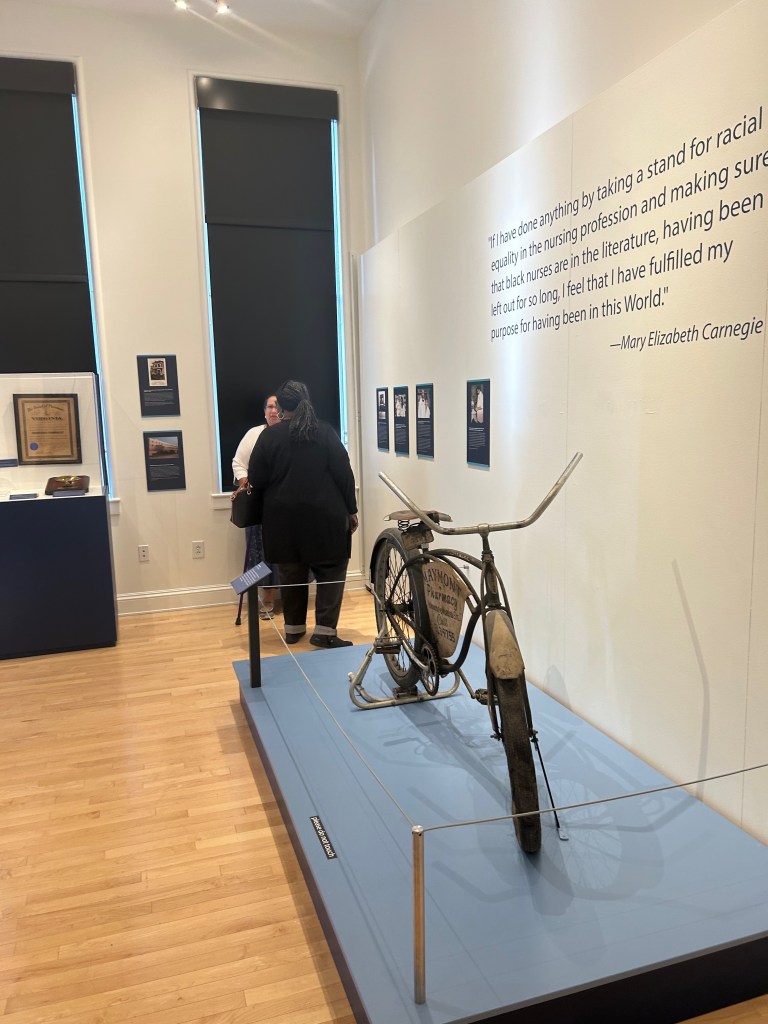
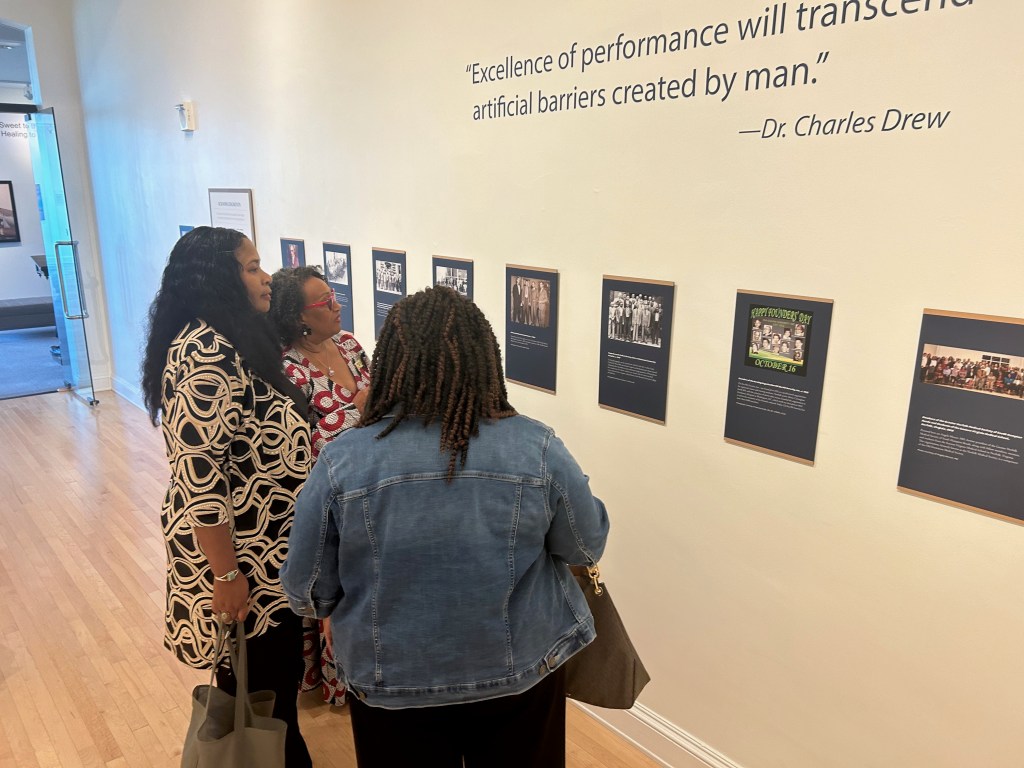
Visitors discuss the contributions of Blacks in the medical professions recently at the Black History Museum and Cultural Center of Virginia.Photos by Bonnie Newman Davis.
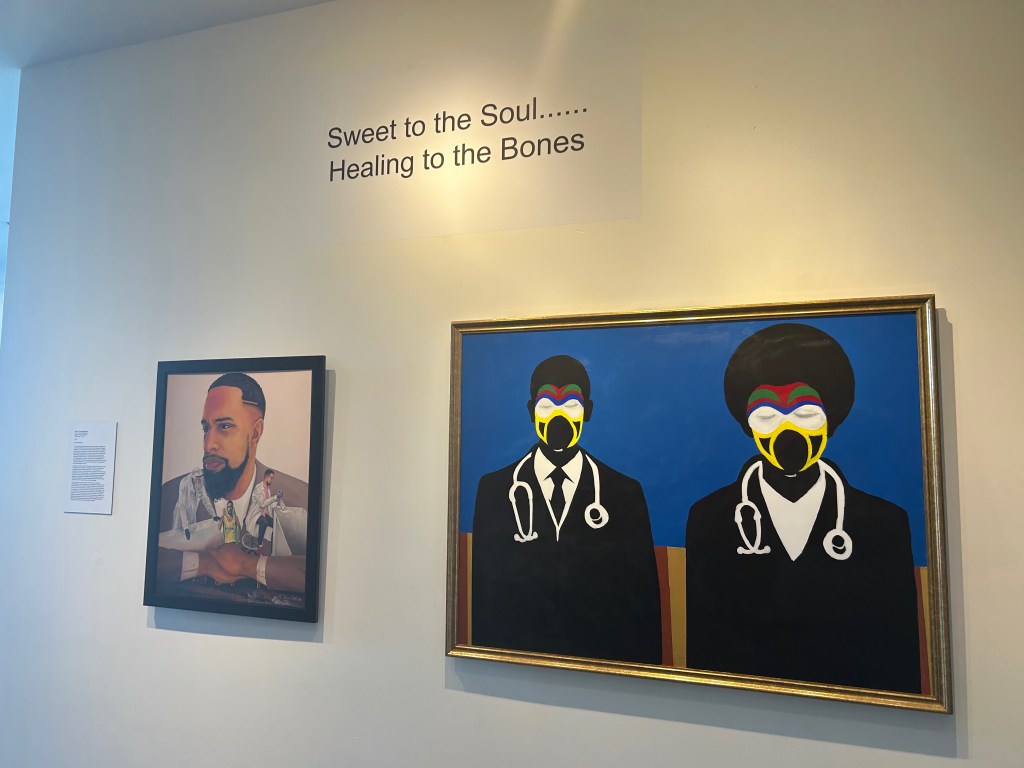
A landmark exhibition that chronicles Virginia’s Black hospitals, medical educators, physicians, pharmacists and professional organizations opened Sept. 18, 2024 at the Black History Museum and Cultural Center of Virginia in Richmond, Virginia.
“A Prescription for Change: How Black Voices Shaped Healthcare in Virginia,” was created and curated by Elvatrice Parker Belsches, B.A., B.S. Pharm, M.A., and features powerful vintage photographs, with accompanying text, of 1919 graduates of the Dixie Hospital Training School for Nurses at Hampton Institute (now Hampton University). Also part of the exhibit is a 1915 group photograph that includes members of the Tri-State Dental Society Conference and founding members of Chi Eta Phi Sorority, a national nursing organization, which had a chapter in Richmond.
The exhibition also showcases rare photos of hospitals created by Black professionals and individuals in the Commonwealth of Virginia. Of notable significance are rare artifacts such as the scales and weights used by Dr. David A. Ferguson, D.D.S., the founding father of the National Dental Association and two dental instruments that reportedly belonged to Dr. Peter B. Ramsey, who began practicing dentistry in the 1880s. There are medical instruments and cabinets from The Claytor Clinic in Roanoke, Virginia. This clinic is believed to be the first multi-specialty clinic in Southwest Virginia that was founded and staffed by Black medical practitioners when it opened in 1948.
Elvatrice Belsches, middle, points to highlights of the exhibit, “A Prescription for Change: How Black Voices Shaped Healthcare in Virginia,” that currently is on view through March 15, 2025 at the Black History Museum and Cultural Center of Virginia in Richmond, Va. Ms. Belsches, a public historian, is the exhibit’s creator and curator.)
The exhibition is divided into eight sections:
*The Early Years
*Education
*Physicians, Optometrists and Chiropractors
*Dentists
*Pharmacy
*Nurses, Midwifery and Doulas
*The Black Hospital Movement
*Organizations
Included in the exhibit are works by 14 artists, exploring physical, emotional, psychological, and historical aspects of healthcare disparities faced by Black patients. Participating artists include P. Muzi Branch, S. Ross Browne, Unicia Buster, Kyle Epps, A. Yhayha Hargrove, Barbara Hobson, William E. Johnson, Jowarnise, David Marion, Amiri Richardson Keys, Jay Sharp, Jeff Taylor, Sir James Thornhill, Dennis Winston, and Vashti Woods. Each artist brings a unique perspective to this critical dialogue, creating a multifaceted narrative that challenges viewers to confront uncomfortable truths and envision a more equitable future in healthcare.
Where: The Black History Museum and Cultural Center of Virginia, 122 W. Leigh St., Richmond, Virginia 23219. The exhibit continues through March 15, 2025.


 BND Institute of Media & Culture