Bryant Terry’s VCU Libraries fall lecture offers “Food For All”

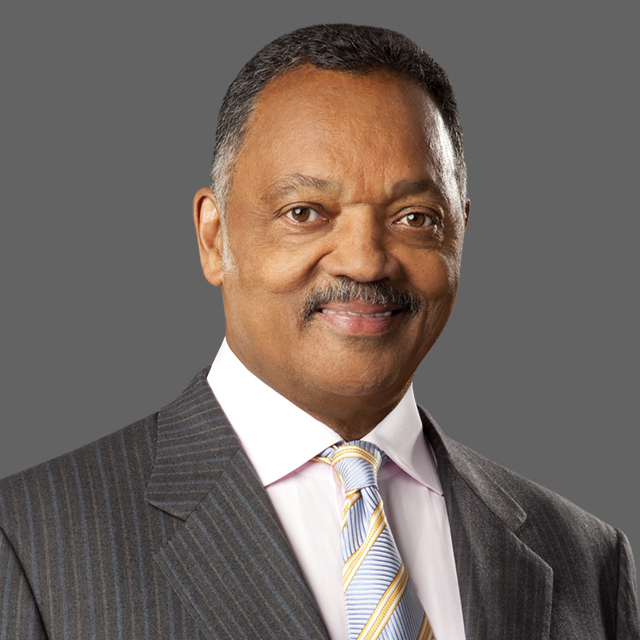
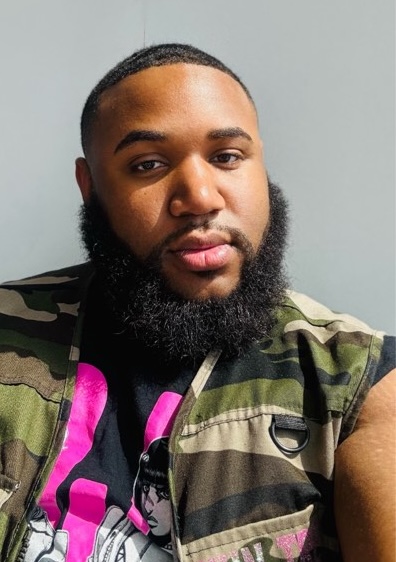
Bryant Terry Photo by Jay Paul

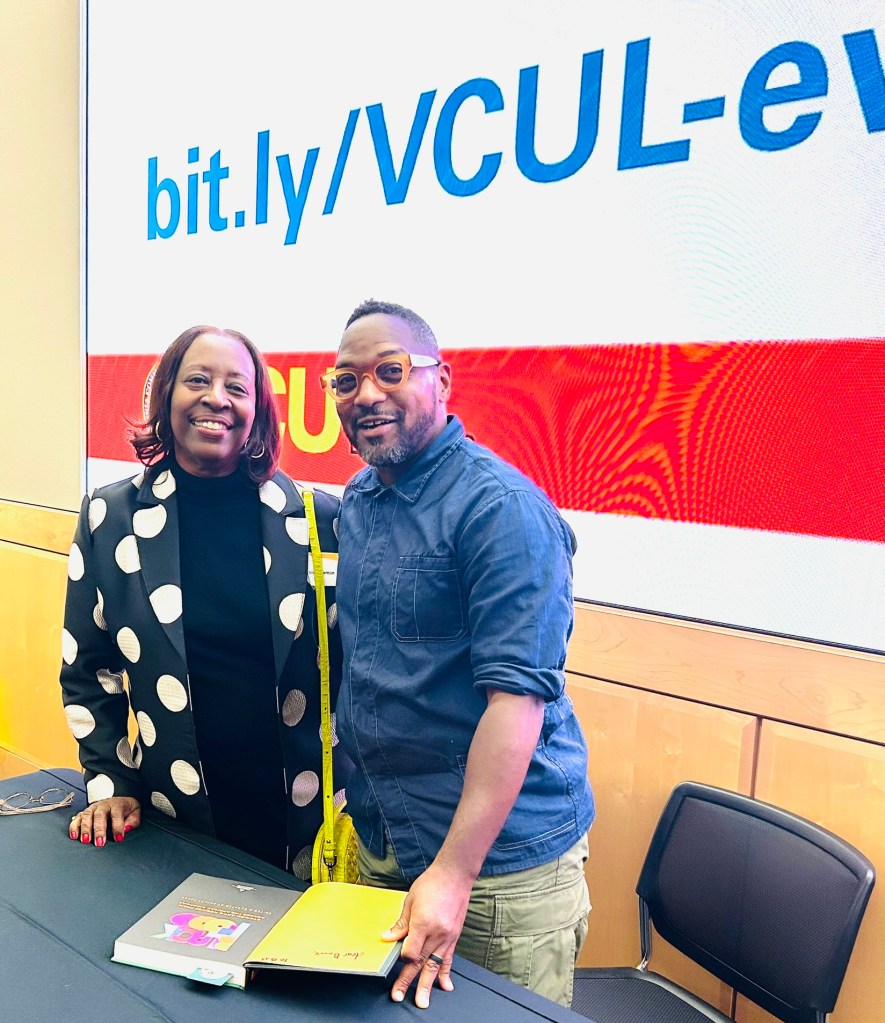
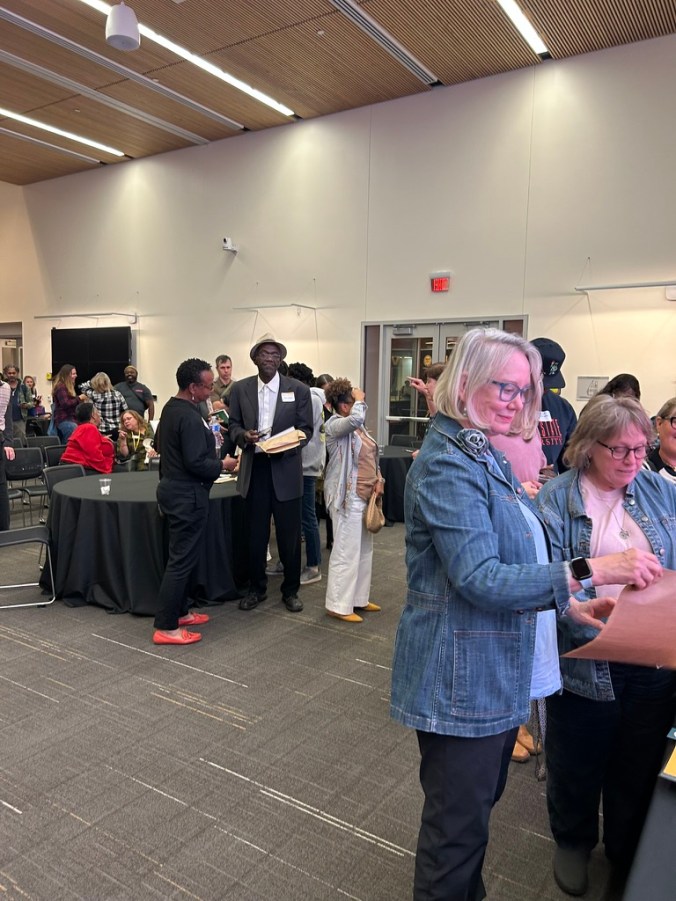
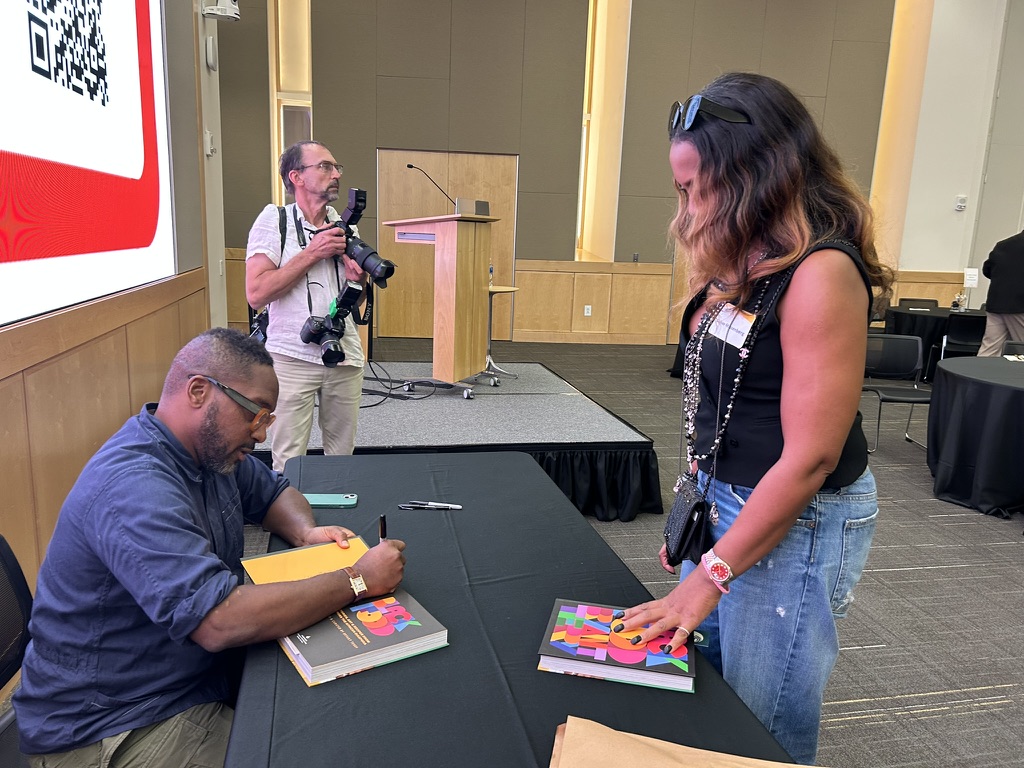
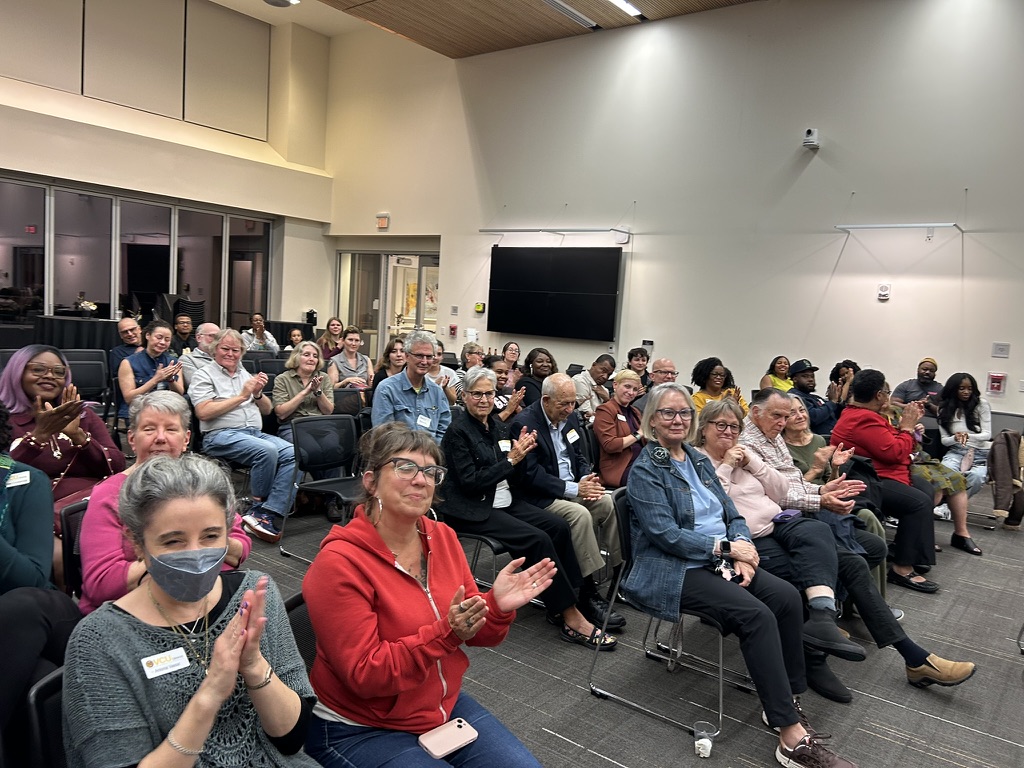
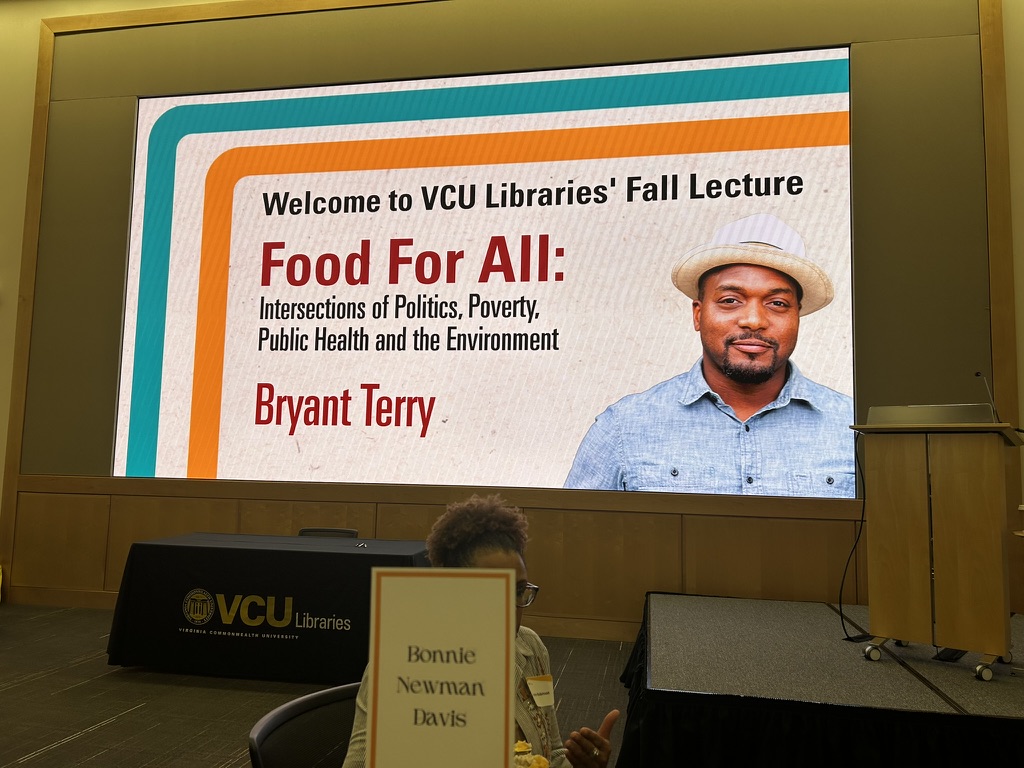
VCU Libraries’ fall lecture, “Food for All” on Oct. 15 with Bryant Terry was a thrilling culinary journey! Bryant, a James Beard Award-winning chef, served up a delectable blend of food, culture, Black history, art, humor, and music. His new book, “Black Food,” promises a flavorful exploration of stories, art, and recipes from the African Diaspora. Huge thanks to Irene Herold, Teresa Knott, Antonia Vassar, Kelly Gotschalk, and Sue Robinson for organizing this thought-provoking lecture. Learn more about Bryant’s lecture below.

2025 Fall Lecture puts activism, art and food justice center stage

By Frances Burson

VCU Libraries’ annual Fall Lecture, Food For All, held Oct. 15, featured chef, author and artist Bryant Terry. Terry took us on a journey through his 25-year multidisciplinary career, blending food justice, publishing, art and activism—all rooted in deep values of interconnection, social justice and community engagement. He shared how his recent MFA from UC Berkeley helped integrate his diverse work into a cohesive studio practice, allowing him to experiment across mediums such as sculpture, sound and mixed media.

His work is deeply influenced by Zen Buddhism, cultural memory and movements like the Black Panther Party, which he referenced as foundational to his food justice activism. Terry shared in detail how projects like Razed Bed #2 and The Table and the Larder transform everyday materials and traditional food practices into living works of art that honor Black resilience and history. 

The talk concluded with a “Recipe for Staying Curious,” a poetic and reflective framework that likened creativity to cooking, requiring preparation, risk, care and improvisation. It was a call to stay open, ask hard questions, and let both failure and joy shape the work. 

At a lunch with public health students and librarians earlier in the day, Terry explored the challenges of eating local, sustainably raised food, retaining food culture after immigration, the global infiltration of highly processed foods, and the impact of food on aging, health, and disease management.

Terry is the author of five cookbooks, including Vegetable Kingdom and Afro-Vegan, and editor of Black Food and The Best American Food and Travel Writing 2025. From 2015 to 2022, he served as the inaugural Chef-in-Residence at San Francisco’s Museum of the African Diaspora, curating dynamic programming connecting food, health, farming, and art. Most recently, he completed an MFA in Art Practice at the University of California at Berkeley in 2025 and was awarded a prestigious Graduate Fellowship at Headlands Center for the Arts for 2025–2026. 

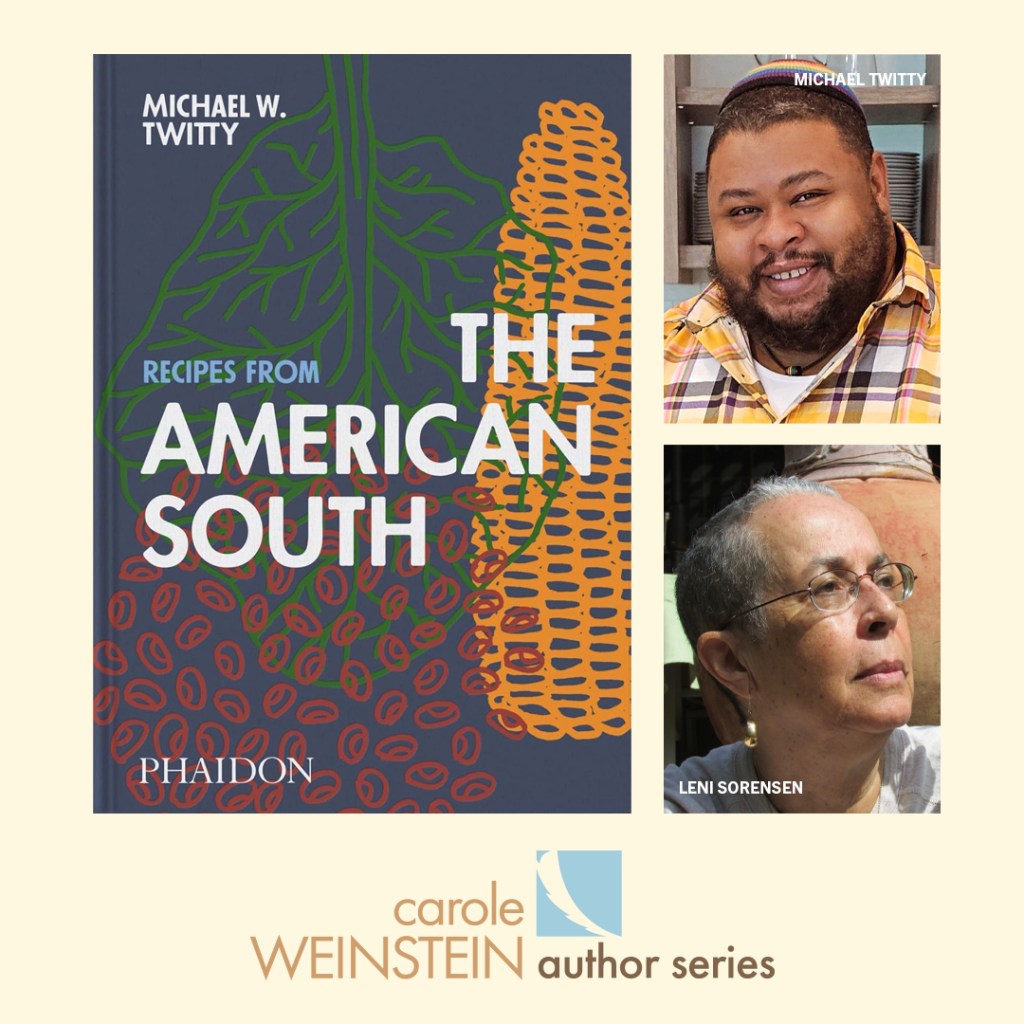
Weinstein Author Series – Michael W. Twitty | Recipes From the American South

Courtesy, Library of Virginia

Join us for a conversation between culinary historian Leni Sorensen and award-winning author and culinary historian Michael W. Twitty on Twitty’s new book, “Recipes From the American South.” Building on the foundation of his James Beard Award–winning memoir, “The Cooking Gene,” Twitty once again brings his unparalleled scholarship, lived experience and eloquent storytelling to his exploration of the South. He showcases the complexity of the food traditions influenced by European, Indigenous, African and immigrant communities. With more than 260 recipes, Twitty offers a broad view of the culinary sweep of Southern history and its many cultures, bringing to life everything from timeless classics to lesser-known regional specialties. “Recipes From the American South” celebrates Southern food’s memory keepers and practitioners.

Leni Sorensen has worked as a university lecturer, museum consultant, hands-on presenter and researcher with a focus on African American slavery, American agriculture, and women’s work in colonial and post-colonial America. She retired as the African American research historian at Monticello, and continues to lecture, consult and write on issues of food history while teaching home provisioning and rural life skills from her home in western Albemarle County. 

REGISTER FOR THIS EVENT

The Carole Weinstein Author Series supports the literary arts by bringing both new and well-known authors to the Library of Virginia through online or in-person events. Free and open to the public, the series focuses on Virginia authors and Virginia subjects across all genres.

A book signing will follow the talk. This book will be available at the Virginia Shop.

This is a free event, but registration is required. Seating in the Lecture Hall is available on a first come, first served basis. Limited free parking is available in the deck underneath the Library building. For more information, contact education@lva.virginia.gov.Calendar: LVA EventsDate:Tuesday, October 28, 2025 Time: 6:00 pm – 7:30 pm; Location:Lecture HallAudience:

House to Highway: Reclaiming a Community History

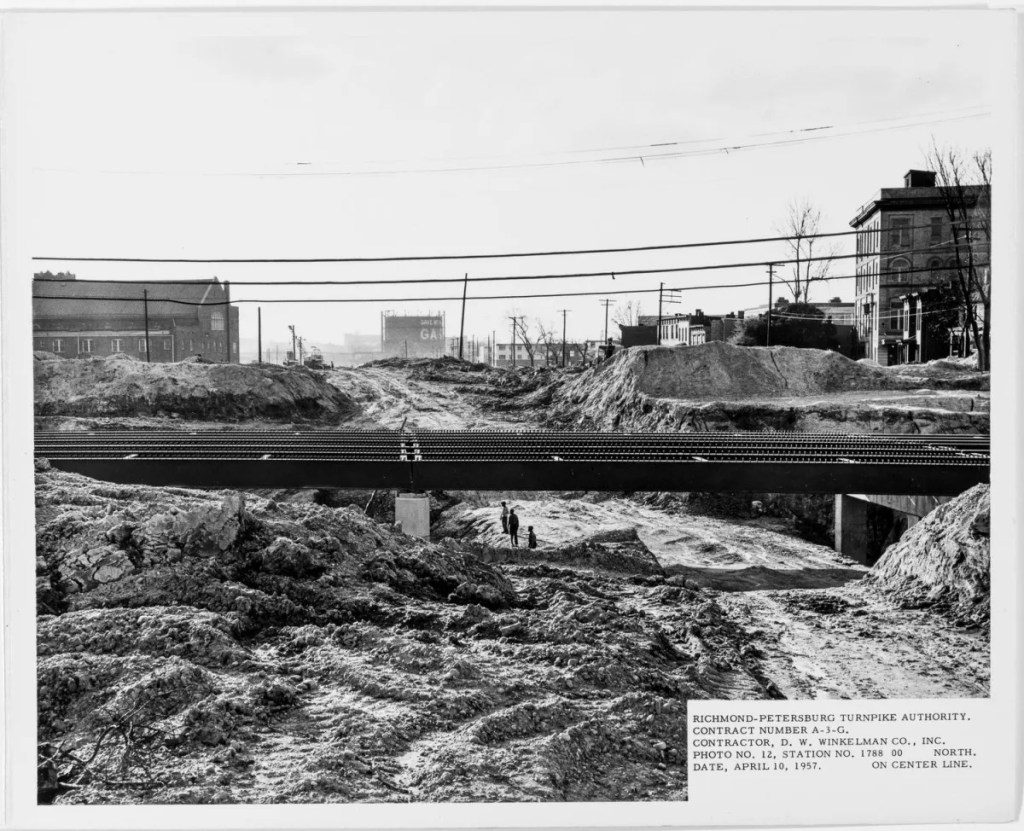
Sixth Mount Zion Baptist Church, pictured on the left, during the construction of I-95 in 1957. Courtesy Library of Virginia.—-Courtesy of Virginia Humanities

On display July 14, 2025 through Feb. 28, 2026

The Library of Virginia’s free exhibition on the history of Richmond’s Jackson Ward neighborhood, House to Highway: Reclaiming a Community History, will explore the historic district that was once the center of Richmond’s Black community through the lens of the Skipwith-Roper family.

Using a combination of archival records, maps and photographs from the Library’s collection, the exhibition covers a period from 1767 through the 1950s, when eminent domain displaced many residents and businesses of Jackson Ward for the construction of the Richmond-Petersburg Turnpike.
 
The exhibition is presented in partnership with The JXN Project (JXN), a historic preservation nonprofit organization dedicated to capturing the pivotal role of the ward in the Black American experience as one of the country’s first historically registered Black urban neighborhoods. 

This project was supported in part by a grant from Virginia Humanities.

Opening Celebration for House to Highway: Reclaiming a Community History

Celebrate the opening of a new exhibition from the Library of Virginia and The JXN Project titled “House to Highway: Reclaiming a Community History.” The exhibition explores the story of Abraham Peyton Skipwith, the first Black homeowner in the area that would be known as Jackson Ward after the Civil War, and the subsequent removal of his house in advance of the construction of the Richmond–Petersburg Turnpike. This history anchors a larger national story of Black American experience from the founding of the nation through the Jim Crow era. 

The opening celebration features information booths from community partners, guided tours of the exhibition and a panel discussion with the exhibition team on the origins of The JXN Project and the exhibition, the historical importance of Jackson Ward, the legacies of the destruction of Jackson Ward and the future of The JXN Project. 

SCHEDULE OF EVENTS

  • 4:00 p.m. | Guided Exhibition Tours & Information Booths
  • 5:45 p.m. | Welcome & Partners’ Remarks
  • 6:15–7:15 p.m. | Panel Discussion with The JXN Project co-founder Dr. Sesha Joi Moon; Dr. Gregg D. Kimball, former director of the Library’s Public Services & Outreach division and senior consulting historian for the Shockoe Institute; Barbara Batson, exhibitions coordinator; Catherine Fitzgerald Wyatt, education and outreach manager; and Ashley Ramey Craig, community engagement & partnerships specialist 


This is a free event. Seating in the Lecture Hall is available on a first come, first served basis. Limited free parking is available underneath the Library at 800 East Broad Street. For more information, contact education@lva.virginia.govCalendar:

Commission for Historical Statues in the United States Capitol to Approve Barbara Rose Johns Statue


The Commission will meet this month to approve the statue of Barbara Rose Johns for the U.S. Capitol’s Statuary Hall Collection

The Barbara Rose Johns maquette as shown from the sides. Photo credit: Julie Langan/DHR.

RICHMOND – The Commission for Historical Statues in the United States Capitol (the Commission) will hold its twelfth public meeting on Wednesday, June 18, 2025. The meeting, which begins at 1:30 p.m., will be in the Reynolds Leadership Center on the 2nd Floor of the Virginia Museum of History & Culture, located on 428 N. Arthur Ashe Boulevard in Richmond.

At this meeting the Commission will review photographs of the completed bronze statue created by sculptor Steven Weitzman depicting the 20th-century civil rights leader Barbara Rose Johns, as well as receive an update regarding the statue’s production. After the statue has been given the final approval from the Commission, the Joint Committee on the Library, and the Architect of the Capitol, it will be installed in the United States Capitol as one of Virginia’s two contributions to the Statuary Hall Collection.

Production of the full-size Johns statue began after the Commission and the Joint Committee on the Library approved the maquette in 2023. The Johns statue will replace the statue of Robert E. Lee that was removed in December 2020. To recommend a replacement statue, the Commission had reviewed a list of names of historical figures submitted by Virginia citizens before selecting Johns from five finalists. The Joint Committee on the Library approved the Commission’s request to erect a statue of Johns in the U.S. Capitol in 2021.

The meeting agenda, as well as instructions for how to participate virtually and to register for public comment, are available on the Commission’s webpage. Though the meeting agenda includes time for verbal public comment, written comment is also welcomed and can be submitted to USCapitolCommission@dhr.virginia.gov.

For more information about Barbara Rose Johns, please visit this link.

The Department of Historic Resources, the Commonwealth’s state historic preservation office, provides administrative support to the Commission. Questions concerning the Commission, its purpose, and the upcoming meeting should be directed to the department.

Virginia’s Department of Historic Resources State Board Approves 9 Historical Highway Markers

Source: Department of Historic Resources


Attucks Theatre, Norfolk. Photo credit: Brad McDonald/DHR, 2022

RICHMOND – The Department of Historic Resources (DHR) has announced nine new historical markers coming to roadsides in Virginia. The markers will recall various topics in the Commonwealth’s history, including an important Native American trade route that was later used during military campaigns in the American Revolution and the Civil War; a 20th-century performing arts theatre in Norfolk’s Black business district that was dubbed the “Apollo of the South”; and the Rev. Dr. Martin Luther King, Jr.’s visits to communities in southern Virginia in the early 1960s, right before the height of the Civil Rights Movement. 

The Virginia Board of Historic Resources approved the markers on March 20, 2025, during its quarterly meeting in Richmond hosted by DHR.

While it was formally established in 1866, the origins of First Baptist Church Bermuda Hundred in present-day Chesterfield County date to 1850. The church is located at a former central marketplace of the colonial period known as Bermuda Hundred, which became one of Virginia’s official trade ports in 1691. Transatlantic slave ships brought thousands of enslaved Africans to Bermuda Hundred to be sold. After circa 1750, when the demand for laborers increased in the newly settled southern Piedmont region of Virginia, Bermuda Hundred became one of the Commonwealth’s largest slave auction sites. Most enslaved Africans who disembarked in Bermuda Hundred, including many children, were sent to tobacco plantations, where planters profited from their labor. The Rev. Curtis W. Harris, a Civil Rights leader, became pastor of First Baptist Church Bermuda Hundred in 1959.

Two new markers highlight events that took place in Virginia during the nation’s Revolutionary and Early Republic eras:

  • The Old Carolina Road in Loudoun County was a Native American trade route that extended across Virginia, linking the Potomac River with the Carolinas. By the mid-1750s, the Old Carolina Road had become an important southward migration route for European settlers, who crossed the Potomac at Noland’s Ferry. The general corridor of the road corresponds to modern U.S. Route 15, though—like many colonial roads—its path often shifted. During the Revolutionary War and Civil War, the road facilitated troop movements through Loudoun County. In May 1776, Thomas Jefferson traveled on the Old Carolina Road to get to Philadelphia, where he attended the Second Continental Congress and drafted the Declaration of Independence.
  • American explorers Meriwether Lewis and William Clark were friends of Botetourt County native William Preston, Jr., and spent time in the county. Clark met his future wife, Julia Hancock, of Santillane, during a visit in the early 1800s. After their expedition to the Pacific Ocean from 1803 to 1806, Lewis and a group of Mandan Indians passed through Botetourt County on their way to Washington, D.C., and Clark was given a congratulatory address from citizens in the Town of Fincastle. Clark was in Botetourt County when he received his commission as a brigadier general of militia for the Louisiana Territory in 1807. He also got married in the county the following year. In 1810, the writer and future financier Nicholas Biddle met with Clark in Fincastle before editing the official narrative of the expedition.

The centrality of the Black church in Black communities of Virginia is exemplified in one new marker:

  • Dedicated on April 18, 1875, Moore Street Missionary Baptist Church in the City of Richmond was established to serve the residents of an area within the Sheep Hill community, later known as Carver. The Rev. William Troy, a founder of the church and its first pastor, was a freeborn man of color from Virginia. Troy became a resident of Canada before the Civil War and was a prominent abolitionist associated with the Underground Railroad. The Moore Street Industrial Institution, a school for Black students, was located on the church’s property. The acclaimed educator Virginia E. Randolph (1870-1958), who was known for her work with Henrico County’s public schools, was a member of the church. The congregation moved to its current location in Richmond in 1908.

Three approved markers focus on political and cultural events that encouraged Black people to embrace their African and African American heritage against Jim Crow and discrimination in early-20th-century Virginia:

  • In 1914, Marcus Garvey founded the Universal Negro Improvement Association (UNIA), an organization that promoted Pan-Africanism, Black economic independence, and racial pride and separatism. In 1918, the UNIA’s sixth division, or branch, was established in the City of Newport News. The UNIA eventually expanded to hundreds of divisions internationally. The branch in Newport News, where Garvey’s message resonated with maritime and industrial laborers, was among the largest divisions. Garvey spoke at the Dixie Theatre and at First Baptist Church in the city in 1919 to raise funds for the UNIA’s steamship company, the Black Star Line. Audience members were among the earliest and most enthusiastic investors. The UNIA was in decline by the 1930s.
  • Nicknamed the “Apollo of the South,” the Attucks Theatre was built in 1919 in the City of Norfolk’s thriving Black business district. Designed by Black architect Harvey Johnson, the Attucks Theatre was financed, constructed, and operated by African Americans. It was named for Crispus Attucks, who was regarded as the first casualty of the American Revolution. Known as the Booker T. from 1934 until it closed in 1955, the theatre was a venue for concerts, movies, plays, and community events, and was listed in the Green Book, a 20th-century guide for Black travelers. Artists who performed at the theatre included Ruth Brown, Ella Fitzgerald, and Dizzy Gillespie. The theatre’s rooms upstairs served as offices for Black professionals. Attucks reopened in 2004 after renovations.
  • On October 24, 1925, Upsilon Omega became Richmond’s first chapter of Alpha Kappa Alpha (AKA) Sorority, Inc., the first Greek-letter organization founded by Black women. Aligning with the sorority’s principles of scholarship, leadership, and service, this graduate chapter focused on supporting students in public schools. The chapter’s inaugural president was Dr. Zenobia Gilpin, a Black female physician during Virginia’s Jim Crow era who organized clinics in Black churches that were emulated elsewhere and who overcame racial inequities in the healthcare industry. Members of the chapter also included Janet Ballard, international president of AKA, and Dr. Grace Pleasants, the first Black national program director of the Girl Scouts of the USA. The chapter began to meet at Fifth Baptist Church in the 1980s.

The Board also approved two markers that recall the Civil Rights Movement in Virginia in the 1950s and ‘60s: 

  • In Lancaster County, Brookvale High School opened to serve Black students in 1959, five years following the U.S. Supreme Court’s decision in Brown v. Board of Education declaring public school segregation unconstitutional. Brookvale replaced A. T. Wright High School, and the Crusaders Political and Social Club, a civil rights organization, met in the school building frequently. In 1969, the Brookvale Warriors won the last state baseball championship overseen by the Virginia Interscholastic Association, the league for Black schools. The county fully desegregated its schools in the fall of 1969. After that, the Brookvale building became an intermediate school. Brookvale’s last principal, Dr. Elton Smith, later became Virginia’s first Black public school superintendent.
  • On March 28, 1962, during a “People to People” tour of communities in southern Virginia, the Rev. Dr. Martin Luther King, Jr., spoke at Mount Level Baptist Church in Dinwiddie County. King and other officials of the Southern Christian Leadership Conference also made stops between Hopewell and Lynchburg, where they addressed crowds and went door-to-door to encourage voter registration and to recruit civil rights workers. King’s visit to Mount Level was planned by his chief of staff, the Rev. Wyatt Tee Walker, who was a former pastor of the church. At Mount Level, King spoke to a full house of people about the importance of voting as a pathway to equality and justice for all. He also visited Dinwiddie County’s Rocky Branch community.

Following the Board of Historic Resources’ approval of the markers, it can take upwards of six months or more before a new marker is ready for installation. The marker’s sponsor covers the required $3,000 manufacturing expenses for a new sign.

Virginia’s historical highway marker program began in 1927 with installation of the first markers along U.S. Route 1. It is considered the oldest such program in the nation. Currently there are more than 2,600 state markers, mostly maintained by the Virginia Department of Transportation, except in those localities outside of VDOT’s authority.

Full Text of Markers:


(VDOT must approve the proposed location for each sign in its right-of-way; local public works departments must do so in jurisdictions outside VDOT’s authority.)

First Baptist Church Bermuda Hundred

First Baptist Church Bermuda Hundred traces its origins to 1850 and was formally organized ca. 1866. The Rev. Curtis W. Harris, a Civil Rights leader, became pastor here in 1959. The church stands on the former central marketplace of Bermuda Hundred, which became one of Virginia’s official ports in 1691. Transatlantic slave ships brought thousands of enslaved Africans here to be sold. When demand for labor surged in the newly settled southern Piedmont after about 1750, this became one of Virginia’s largest slave auction sites. Most enslaved Africans who disembarked here, including many children, were marched to tobacco plantations in the interior, where planters profited from their labor.
Sponsor: Chesterfield Historical Society of Virginia
Locality: 
Chesterfield County
Proposed Location: 4601 Bermuda Hundred Road

Old Carolina Road
A Native American trade route that traversed Virginia, linking the Potomac River with the Carolinas, passed by here. By the mid-1750s, this “Carolina Road” had become an important southward migration route for settlers of European descent, who crossed the Potomac at Noland’s Ferry 3.5 miles northeast of here. Like many other colonial roads, its path often shifted, but its general corridor corresponds to modern US Route 15. During the Revolutionary War and Civil War, the Carolina Road facilitated troop movements through this area. In May 1776, Thomas Jefferson traveled this route to Philadelphia, where he attended the Second Continental Congress and drafted the Declaration of Independence.
Sponsor: Lucketts Ruritan Club
Locality: 
Loudoun County
Proposed Location: 
Lucketts Community Center, Lucketts Road just east of US 15

Lewis and Clark in Botetourt County
Meriwether Lewis and William Clark were friends of Botetourt Co. native William Preston Jr. and spent time here. On a visit early in the 1800s, Clark met his future wife, Julia Hancock, of Santillane. After the expedition to the Pacific Ocean (1803-06), Lewis and a group of Mandan Indians passed here on their way to Washington, D.C., and Clark received a congratulatory address from the citizens of Fincastle. Clark was here when he received his commission as brigadier general of militia for the Louisiana Territory in 1807 and was married here in 1808. Nicholas Biddle, a young writer and future financier, met with Clark in Fincastle in 1810 before editing the official narrative of the expedition.
Sponsor: Virginia Lewis and Clark Legacy Trail
Locality:
 Botetourt County
Proposed Location: TBD

Moore Street Missionary Baptist Church
Moore Street Missionary Baptist Church, originally several blocks east of here, was dedicated on 18 April 1875 to serve an area of the Sheep Hill community later known as Carver. The Rev. William Troy, a founder of the church and its first pastor, was a freeborn man of color from Virginia who, as a resident of Canada before the Civil War, had become a prominent abolitionist associated with the Underground Railroad. On the church’s property stood the Moore Street Industrial Institution, a school for Black students. Church member Virginia E. Randolph (1870-1958) became widely known as an educational innovator through her work in Henrico County’s schools. The congregation moved here in 1908.
Sponsor: Moore Street Missionary Baptist Church
Locality: 
City of Richmond
Proposed Location: 1408 W. Leigh Street

The Garvey Movement in Newport News
Marcus Garvey founded the Universal Negro Improvement Association (UNIA) in 1914 and launched its sixth division, or branch, in Newport News in 1918. The UNIA, which expanded to hundreds of divisions internationally, promoted Pan-Africanism, Black economic independence, and racial pride and separatism. The branch in Newport News, where Garvey’s message resonated with maritime and industrial laborers, was among the largest. Garvey spoke near here at the Dixie Theatre and at First Baptist Church in Newport News in 1919 to raise funds for the UNIA’s Black Star Line, a steamship company. Audience members were among the earliest and most enthusiastic investors. The UNIA was in decline by the 1930s.
Sponsor: City of Newport News
Locality: 
City of Newport News
Proposed Location: Intersection of 23rd Street and Jefferson Avenue

Attucks Theatre
The Attucks Theatre, known as the “Apollo of the South,” was built in 1919 in Norfolk’s thriving Black business district. It was financed, constructed, and operated by African Americans and was designed by Black architect Harvey Johnson. Named for Crispus Attucks, regarded as the first casualty of the American Revolution, the theatre was a venue for concerts, movies, plays, and community events. Performers here included Ruth Brown, Ella Fitzgerald, and Dizzy Gillespie. Rooms upstairs served as offices for Black professionals. The theatre, known as the Booker T. from 1934 until it closed in 1955, was listed in the Green Book, a guide for Black travelers. It reopened in 2004 after renovations.
Sponsor: City of Norfolk
Locality: 
City of Norfolk
Proposed Location: 1010 Church Street

AKA Upsilon Omega
On 24 Oct. 1925, Upsilon Omega became Richmond’s first chapter of Alpha Kappa Alpha Sorority, Inc., the first Greek-letter organization founded by Black women. This graduate chapter, following the sorority’s principles of scholarship, leadership, and service, focused on supporting students in public schools. Inaugural chapter president Dr. Zenobia Gilpin battled racial inequities in health care and organized clinics in Black churches that were emulated elsewhere. Other members included Janet Ballard, international president of AKA, and Dr. Grace Pleasants, the first Black national program director of the Girl Scouts of the USA. The chapter began meeting at Fifth Baptist Church in the 1980s.
Sponsor: Alpha Kappa Alpha Sorority, Inc., Upsilon Omega Chapter
Locality: 
City of Richmond
Proposed Location: 1415 W. Cary Street

Brookvale High School
Lancaster Co. opened Brookvale High School to serve Black students in 1959, five years after the U.S. Supreme Court declared public school segregation unconstitutional. The building replaced the old A. T. Wright High School. The Crusaders Political and Social Club, a civil rights organization, met here frequently. In 1969 the Brookvale Warriors won the last state baseball championship overseen by the Virginia Interscholastic Association, the league for Black schools. Lancaster Co. fully desegregated its schools in the fall of 1969, and the Brookvale building became an intermediate school. Brookvale’s last principal, Dr. Elton Smith, later became the first Black public school superintendent in VA.
Sponsor: Save Brookvale History
Locality: 
Lancaster County
Proposed Location: 36 Primary School Circle

Dr. King at Mount Level Baptist Church
The Rev. Dr. Martin Luther King Jr. spoke at Mount Level Baptist Church on 28 March 1962 during a “People to People” tour of communities in southern Virginia. King and other officials of the Southern Christian Leadership Conference made stops between Hopewell and Lynchburg, addressing crowds and going door-to-door to encourage voter registration and to recruit civil rights workers. The Rev. Wyatt Tee Walker, King’s chief of staff and a former pastor of Mount Level, planned the visit to this church, where King spoke to a full house about the importance of voting as a pathway to equality and justice for all. King also made a stop in the Rocky Branch community of Dinwiddie County.
Sponsor: Dinwiddie County
Locality: 
Dinwiddie County
Proposed Location: 14920 Courthouse Road

Contact: 
Ivy Tan
Department of Historic Resources
Marketing & Communications Manager
ivy.tan@dhr.virginia.gov 
804-482-6445

In era of chaos, ‘Boots on the Ground’ dance brings escape with a beat

By Bonnie Newman Davis

NABJ Black News & Views

Posted April 3, 2025


RICHMOND — Minutes before Kendrick Lamar’s halftime performance at February’s Super Bowl LXI game, several people gave an impromptu dance show of their own at a suburban home near Richmond, Virginia. 

Onlookers were surprised when the dancers of various ages did not perform the Cha Cha Slide, Cupid Shuffle or the Wobble — popular line dances that have prevailed at many Black social gatherings for the past three decades or more.

Instead, the dancers, holding colorful hand fans, debuted a new line dance to “Boots on the Ground (Where Them Fans At),” a gritty Southern song with a catchy beat. The fans’ rhythmic “clack, clack, clack” after each break or dance sequence produced squeals of joy from everyone in the room.

Thanks to social media, the song and dance with a “wrist” have gone viral. Both have been played and performed nonstop since the song dropped in December 2024. Artist 803Fresh, aka Douglas Furtick, of Wagener, South Carolina, wrote and recorded the song. Jaterrious Trésean Little, aka Trè Little of Newnan, Georgia, is credited with creating the dance steps for the tune.

While still trying to process the wide support he’s attracted for “Boots on the Ground,” 803Fresh believes that its popularity is based on the song’s relatability factor.

The artist told WIS 10 (Columbia, S.C.) reporter Billie Jean Shaw last month that he wrote and recorded the song after attending a “trail ride,” a country party with Black culture influences. Trail rides can feature a horseback procession, zydeco, Southern soul, or hip-hop fusion music, along with dancing and feasting, according to various online sources. Attendees can number in the thousands, with many returning to the South for the gatherings from cities across the country, noted a “Black Women on Reddit” post.

Kemel Patton, Richmond's "Line Dance King," teaches the "Boots on the Ground" dance at the Pine Camp Arts and Community Center. Photo credit: Bonnie Newman Davis, NABJ Black News & Views
Kemel Patton, Richmond’s “Line Dance King,” teaches the “Boots on the Ground” dance at the Pine Camp Arts and Community Center. Photo credit: Bonnie Newman Davis, NABJ Black News & Views

During his first trail ride, 803Fresh noticed that many attendees toted hand fans, but the fans were absent on his second trail ride. His observation led to “Boots on the Ground” and its subtitle, “Where Them Fans At.”

After listening to the song with the lyrics, it will probably come as no surprise that 803Fresh grew up hearing a combination of Southern soul and country often filled with bass guitar, drums, blues, and gospel.

“Get up by your seat (your seat), let your body move (move)

Cowboys and cowgirls are feeling that groove (feeling that groove)

Sippin’ on moonshine, fire barrel rollin’ (rollin’)

I’ma get behind that thing, girl, and hold it, hold, it, hold it, hold it

In addition to performing in the church, he enjoyed listening to blues and soul singers such as James Brown, Marvin Sease, Tyrone Davis, and Z.Z. Hill. 

“It’s a beautiful marriage,” he said of his sounds and those of soul singers who dominated the charts from the 1960s until the mid-1970s. “I do my two steps and I’m done. It’s good times, fans, a lot of boots wearing and engaging with the crowd.”

Birth of a trend

Not long after hearing the song for the first time, Trè Little, 22, took the tune to another level, going beyond 803Fresh’s two steps to create a line dance for the song. 

Trè Little created the “Boots on the Ground” line dance.

But the dance actually came by accident when Little, a dancer all his life, tripped over his feet on one of the turns, he said during a recent telephone interview.

 “After I tripped over my feet, it was like that part had to go with the song,” Little recalled. “So I had to add that front step and turn into it. And that was really then I just started, like, just going with the flow. Everything just came together like a puzzle, basically.”

After Little recorded himself dancing to the song and posting it to social media, it generated 100,000 views overnight, he said. “Oh, my goodness! Yes!  And then it just blew up from there.”

Once Little posted online tutorials demonstrating the dance, others in the line dance community joined in. He has since met 803Fresh and they plan to collaborate on more music and dance steps, he said.

“We talk here and there and whenever he has a band in Atlanta or somewhere in this area he calls and we get together,” Little said.

Kemel Patton, Richmond’s “Line Dance King,” with two of his “Boots on the Ground” students at the Pine Camp Arts and Community Center. Photo credit: Bonnie Newman Davis, NABJ Black News & Views

One community’s love affair with ‘Boots on the Ground’

Meanwhile, back in Richmond, a city that produced musical legends such as Jerome Brailey, D’Angelo, Stu Gardner, Mable Scott, Bill “Bojangles” Robinson, and Lonnie Liston Smith, fans continue to boogie to “Boots on the Ground.”

Options to feed their dance hunger appear unlimited because community centers, churches, restaurants, and other facilities routinely host line-dance classes or events throughout the city.

On a recent sunny Saturday, Christopher Woody, who once performed with the UniverSoul Circus, led his first line-dance event at the Satellite Club on Richmond’s Southside. The 3 p.m. to 7 p.m. event, organized just two weeks in advance, drew nearly 100 people. Many of the partiers who learned about the gathering on social media were Black women, dressed in Western wear and armed with colorful folding hand fans. (Fans range in cost, from $2.99 on Temu to $8.99 and up on Amazon.)

Woody, 40, a mental health technician, has been line dancing for 10 years. He decided to teach the dance at the suggestion of a friend.

Christopher Woody with a line dance ethusiast. Photo credit: Bonnie Newman Davis, NABJ Black News & Views

Teaching is different because everything’s at a faster pace when dancing, he said. “So, when you’re teaching, you have to slow it all the way down. Everything is step by step.”

Woody believes that part of the reason the line dance went viral so quickly is the current U.S. political stage, where uncertainty reigns.

“I think in a time like this, people want to get together and have, like, you know how the old cookout used to be?” he said.  When you had people that got together to simply enjoy themselves, set aside their concerns for a while.”

Kemel Patton, affectionately known as the “Line Dance King” in Richmond, agrees. Patton, 63, a line dance instructor for three decades, has relied on dance to help minimize his battle with multiple sclerosis, a chronic, autoimmune disease that affects the central nervous system.

Through the years, Patton has seen as many as 350 people show up for his classes at various venues—from vacant food courts at dying malls to the Virginia Museum of Fine Arts’ marbled halls, as well as the Black History Museum and Cultural Center of Virginia.

Given his longevity in the line dance community, Patton sees the “Boots on the Ground” phenomenon as more than a “great hip-hop vibe with a country feel.”

Rather it also is “a song and dance that let’s folks know that our culture goes beyond just one type of music,” he said, adding, “that the root of all music started with us.”

Virginia Humanities’ 50th Anniversary features David Brooks and Barbara Lee Hamm

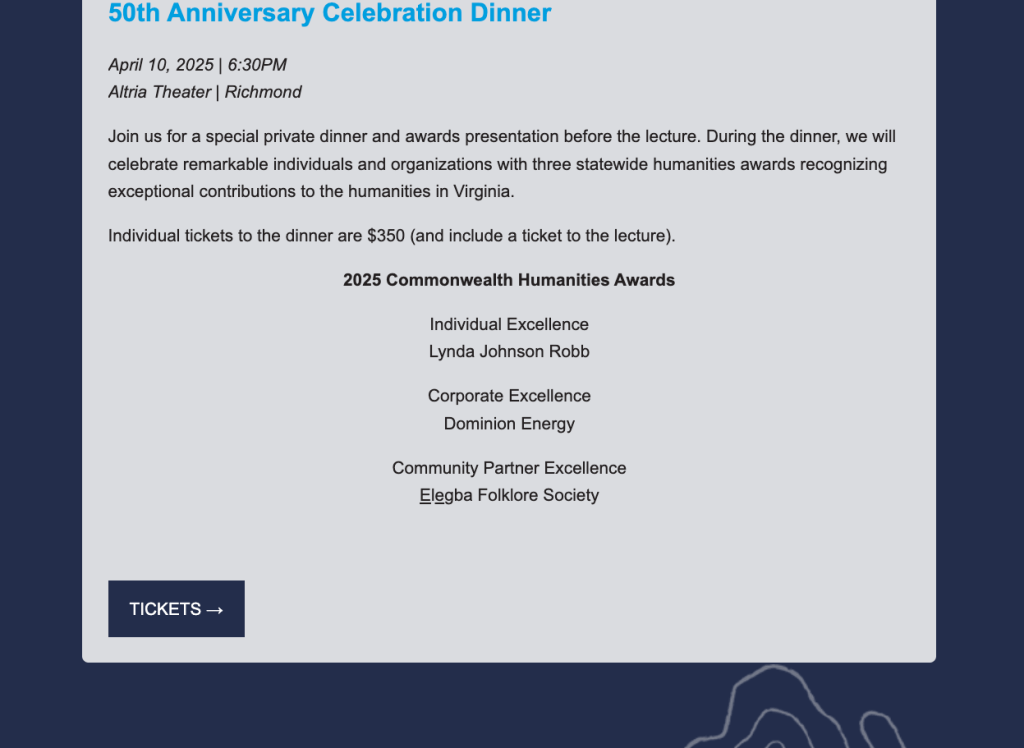
Lynda Johnson Robb, Dominion Energy and Elegba Folklore Society will be honored with “Commonwealth Humanities Award”

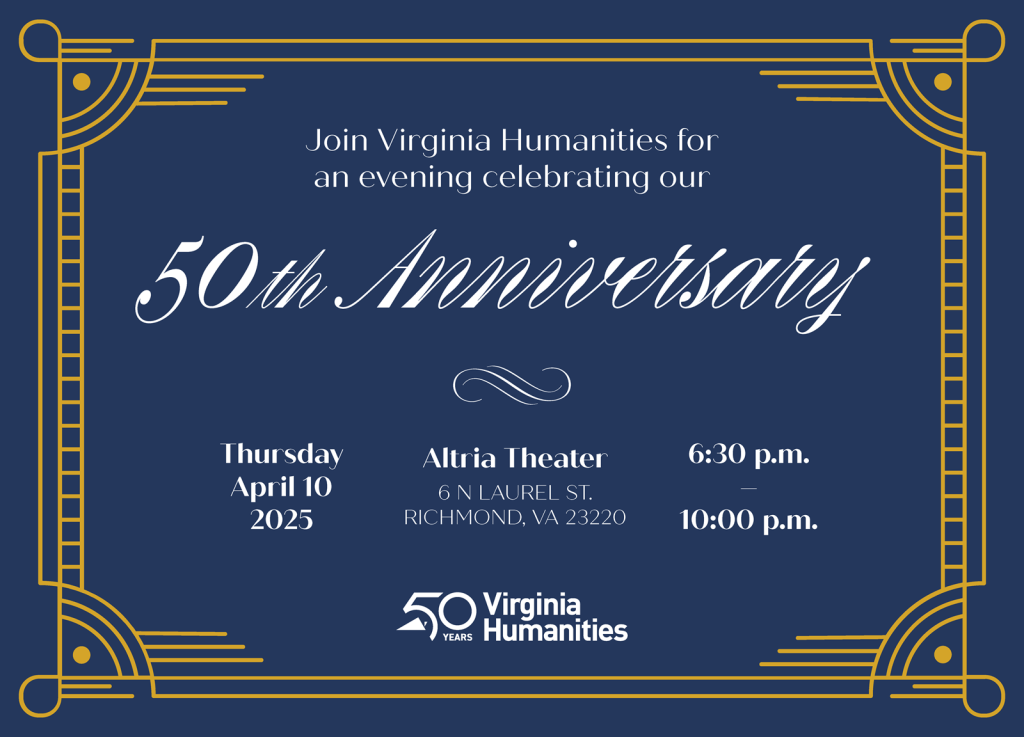
Virginia Humanities will host its inaugural Commonwealth Lecture in the Humanities at the Altria Theater in Richmond on April 10.

“Our celebration of 50 years as your state humanities council is continuing despite the challenges to our federal funding that are currently happening at the National Endowment for the Humanities,” reads a statement announcing the lecture.

“We have a lot to be proud of and to look forward to. We hope you’ll join us and gain a better understand why the humanities matter, how they help us understand our past and present and the role they can play in shaping a more positive future.”

Before the public lecture by David Brooks, three individuals/organizations will be honored with a “Commonwealth Humanities Award.” Lynda Johnson Robb, Dominion Energy, and Elegba Folklore Society will each be honored and will receive a unique work of art made by Page County basket maker, Clyde Jenkins.

About David Brooks:

David Brooks is one of the nation’s leading writers, authors and commentators. Brooks is an op-ed columnist for The New York Times, a writer for The Atlantic, and appears regularly on PBS Newshour. The lecture will examine the intersections of public life and culture, exploring how the humanities is relevant in today’s world, especially in a civically engaged society.

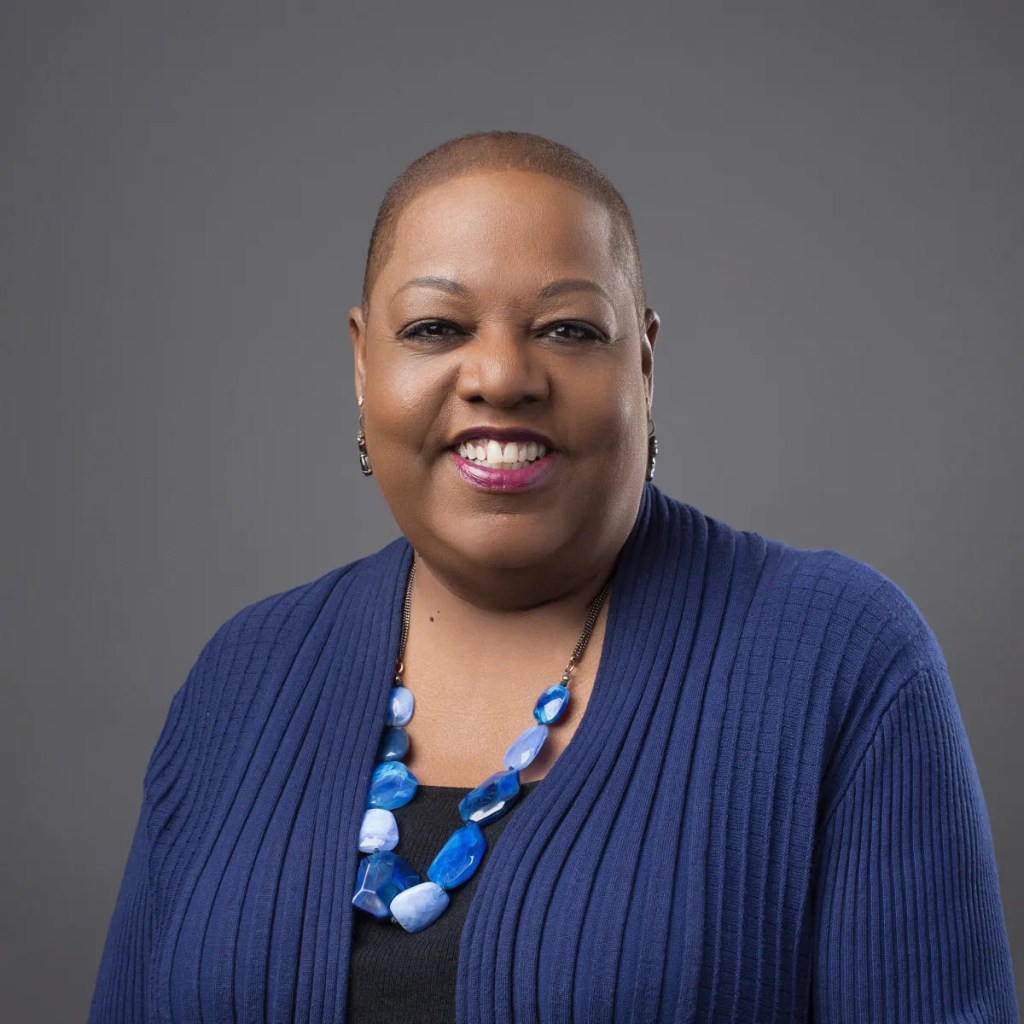
Following the lecture, there will be a moderated conversation by Barbara Hamm Lee. Barbara Hamm Lee is an award-winning journalist, radio and television host of Another View. Audience members will have the opportunity to submit questions in advance. The event is designed to foster deeper reflection on how the humanities are important to continue to shape our society.

The Commonwealth Lecture in the Humanities series is designed to foster deeper reflection on how the humanities continue to shape and respond to societal shifts. This is a signature event of Virginia Humanities’ year-long 50th anniversary celebration. The First Lady of Virginia, Suzanne S. Youngkin, is the honorary chair of the Commonwealth Lecture in the Humanities.

For more information, please click this link.

The Jefferson Monticello Black Family History Lab highlights Black family legacies Feb. 21-22

Courtesy, The Jefferson Monticello

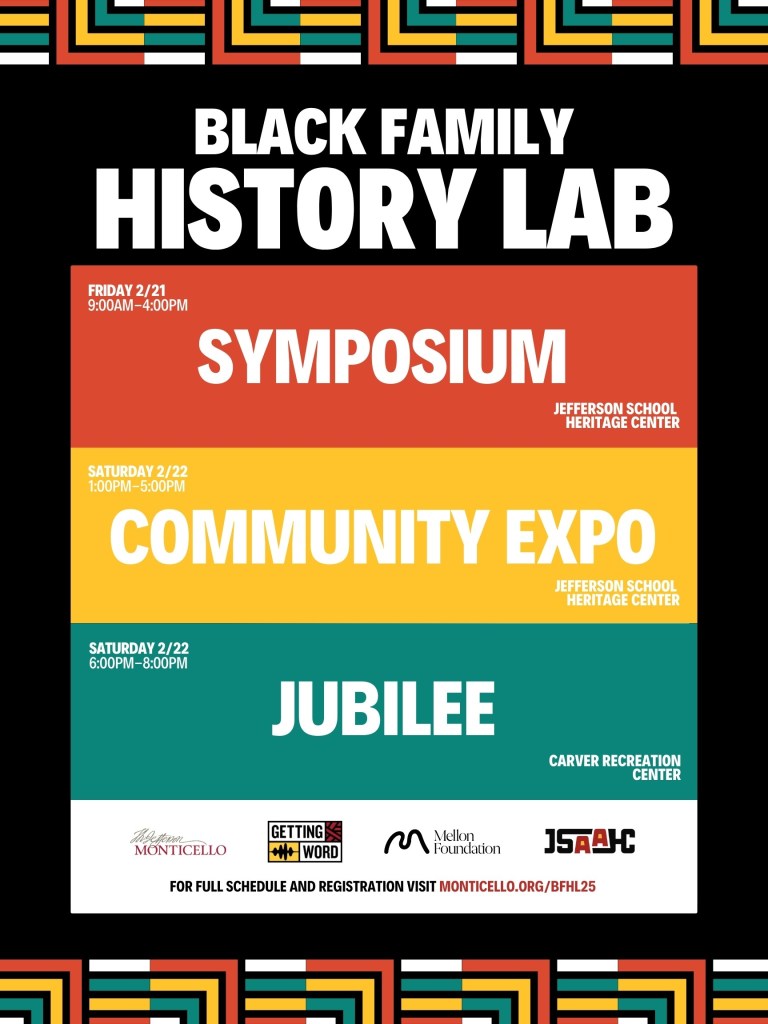
Back for 2025Getting Word’s Black Family History Lab is a two-day program highlighting the interconnectedness of Black family legacies in the spirit of Ubuntu, an African philosophy meaning, “I am because we are.”

On Friday, February 21, join us for our Black Family History Lab Symposium at the Jefferson School African American Heritage Center. The symposium will explore the interwoven ties that bind together local and familial African American histories in Central Virginia and beyond. Engage in enriching panels, interactive workshops, and connect with others to foster a deeper sense of community, connection, and care.

For the full Symposium schedule and free registration, please visit this link.

On Saturday, February 22, come out for our Black Family History Lab Expo at the Jefferson School African American Heritage Center, where the richness of history meets the power of community! This event brings together a diverse mix of community-based organizations and local specialists to build a comprehensive network of support, inspiration, and resources tailored to help you safeguard your family’s legacy for the next generation. 

Finally, the culminating event of the Black Family History Lab, the Jubilee Celebration, will take place at the Carver Recreation Center, featuring music, dance, and poetry performances by local organizations and artists that honor our heritage through their chosen medium.

Be sure to also check out our Facebook event page for other information and updates.


An event by the Getting Word African American Oral History Project in collaboration with The Jefferson School African American Heritage Center and over twenty local community organizations.

The Getting Word African American Oral History Project and the Black Family History Lab are generously supported by The Mellon Foundation.


Schedule

Friday, February 21, 9:30 AM – 4:30 PM Saturday, February 22, 2025, 1:00 PM – 5:00 PM Saturday, February 22, 2025, 6:00 PM – 8:00 PM

Visit here for more information

Five Richmond-area entrepreneurs complete Goldman Sachs’ latest Black in Business program

Local Black women business owners are not just participants in the business world —they are leaders, innovators, and changemakers!

RICHMOND, Va., Feb. 7, 2025 – Richmond is buzzing with entrepreneurial spirit, and leading the charge are dynamic Black women entrepreneurs who are reshaping the business landscape.

In a groundbreaking initiative, five phenomenal Richmond-area women have graduated from the largest cohort yet of Goldman Sachs’ program, “One Million Black Women: Black in Business.” Launched in February 2022, this program offers a free, tailored business education program in partnership with NYU Stern School of Business to empower sole proprietors to overcome challenges and thrive. In a recent survey of Black in Business graduates, 65% of alumni reported increasing revenues, 90% believe the program gave them tools to innovate, and 94% of Black in Business alumni are optimistic about future growth.

The legacy of trailblazers such as Maggie L. Walker and MBL continues to inspire new generations of entrepreneurs.

Meet the trailblazers who are December 2024 graduates of the “One Million Black Women: Black in the Business” program:

·      Joli Aslan, the visionary behind CapConx Management Solutions;

·      Shirley Crawford, the dynamic force at 2nd Chance Consulting;

·      Keonna Knight, the inspiring CEO and courage coach of Heal with Keonna;

·      Erin Stanley, the compassionate psychotherapist and founder of Honey Bee Therapy;

·      Janique Washington, the innovative cranial prosthetics specialist at The Chic Studio.

These women describe their experience with the “Black in Business” program as “phenomenal,” “transformative,” and “life-changing.” Keonna Knight likened it to a hands-on business school, emphasizing the practical, actionable insights she gained. Joli Aslan shared how the program fueled her confidence to dream bigger, while Shirley Crawford is already revamping her business with newfound passion and fire.

The program not only equipped the women with a one-year action plan, but also connected them to a vibrant network of like-minded entrepreneurs, a crucial support system for solo entrepreneurs. As Janique Washington noted, this sense of belonging is invaluable.

“I was honestly blown away,” Aslan said, noting she sees her developed confidence to dream bigger dreams as a payoff already.

But it wasn’t only good feelings that participants left with. They each also developed a one-year action plan over the 12-week course and already began the first steps in implementing it.

Crawford has begun changing her website and creating new programs.

“It [the program] has helped me to really think about my business from scratch and revamp my focus,” she said. “I’m feeling super passionate and so on fire.”

Stanley’s focus has been on time management – something she says the program taught her is paramount if she wants to expand her impact and her income. However, she gained something else – a wide network of women from different backgrounds and fields to connect with.

This was a bonus important to all five women because, as Washington added, being a solo entrepreneur can be lonely.

“Just having people available gives you a sense of belonging, and that’s something that I didn’t have before,” she said.

When asked what encouragement they have for other Black women with entrepreneurial dreams, the resounding answer of the group was, “Go for it!”

“There are lots of opportunities available and out there,” Stanley said. “So use your voices because they matter.”

Richmond Free Press Article, Feb. 13, 2025

Continuing legacy of the Obama presidency focus of VCU 2025 Black History Month Lecture

From VCU Libraries Website

A collage of Dr. Crystal M. Moten and the proposed model of the Obama Presidential Center

Recent history and future community-building will be the focus of VCU Libraries’ annual Black History Lecture Feb 4, 2025, “Building a Home for Change: The Obama Presidential Center.”

The Center’s Curator of Collections and Exhibitions, Dr. Crystal M. Moten, will provide an  overview of the Obama Presidential Center focusing on the center’s museum exhibits. She will: explore the ways the exhibits are rooted in a larger, complex discussion about democracy; highlight the historical predecessors who made President and Mrs. Obama’s stories possible; and share the museum’s storytelling goals as they relate to the events, policies, challenges and accomplishments of the Obama Presidency. In harnessing the power of storytelling, the Center hopes to inspire all of its visitors to push for change within their own communities.

The Obama Presidential Center (OPC) will open in Chicago in spring 2026. Set in historic Jackson Park, in the heart of the city’s south side, the center spans 19 acres and will feature a fruit and vegetable garden; an athletic, programs, and events facility; a world-class museum; an auditorium; a branch of the Chicago Public Library; and more.

The Center, through its mission, museum and programs, will be a physical demonstration of how making change at home is the most meaningful way to participate in democracy and impact the world.

The speaker is a public historian, curator and writer who focuses on the intersection of race, class and gender to uncover the hidden histories of Black people in the Midwest. In 2022, Moten joined the Obama Foundation as the inaugural Curator of Collections and Exhibitions on the Presidential Center Museum team. She plays a key role in the collaborative effort to complete the design and implementation of the inaugural exhibits while also serving as the primary steward and subject matter expert of the Obama Foundation Museum Collection. Moten supervises and manages the curatorial team and its activities.

She has been researching African American life, history, culture, politics and work for nearly two decades and sees her work at the Obama Center as a  “culminating moment in terms of bringing together the personal, professional, and the intellectual.”

In an online interview, Moten put the project in perspective: 

         “For the Obama Presidential Center, we really want people to understand that it was a collective set of actions that got President Obama to where he is today. We are telling the story and the history of President Obama becoming the nation’s first Black president. We are explaining the buildup that happened way before 2008, focusing on what led to President Obama’s historic victory, diving into the eight years of his administration, the pushback and the obstruction that happens at the end of his administration, and civic action that empowers everyone to engage in democracy.

         “We want to show that together we can create the change we desire. All of our small actions added together is what moves the mountain. What history tells us is that change takes time. And I think that’s what the Presidential Center also shows. The way in which we agitate for change and the time that it takes, it’s not going to happen immediately. It didn’t happen over eight years. There’s still work to be done.”

Prior to joining the Obama Foundation, Moten served as Curator of African American History in the Division of Work and Industry at the Smithsonian National Museum of American History in Washington, DC. There, she stewarded collections as they related to the history of African Americans in business and labor; collaborated on several exhibitions; wrote for the Museum’s blog; and helped start, produce, and host “Collected,” a Smithsonian Podcast on African American History. She also reviewed and appeared on documentaries for the Smithsonian Channel including, She the People: Votes for Women.

The recipient of numerous awards and honors, Moten has taught at colleges and universities across the country including the University of Wisconsin, Milwaukee; Dickinson College; Macalester College; and American University. Her research has appeared in books, journals, documentaries and other media. 

A lifetime member of the Association of Black Women Historians, she serves on the Board of Directors for the Midwestern History Association and the Labor and Working Class History Association; the Executive Committee of the Association for the Study of African American Life and History; as well as the Board of Editors for the American Historical Review. 

Her most recent, award-winning book is Continually Working: Black Women, Community Intellectualism and Economic Justice in Postwar Milwaukee (Vanderbilt University Press, 2023). 

She studied African American Studies and anthropology at Washington University in St. Louis and received a master’s degree in African-American Studies and a doctorate in history from the University of Wisconsin Madison.   

Registration is now open. The lecture is free and open to all. Seating is limited. The lecture will be held at James Branch Cabell Library at 7 p.m. Feb. 4, 2025. 

VCU Libraries’ Black History Month Lecture is supported by the Francis M. Foster Fund. [https://www.support.vcu.edu/give/fund?fund=4924]  Francis Merrill Foster Sr., DDS, was an assistant professor of general-practice dentistry at Virginia Commonwealth University and a retired Richmond dentist. The unofficial historian of Jackson Ward, Foster was known for his health-care advocacy and for his desire to improve the lives of those around him.